SICON — An Ontology Design Pattern to model visual representations on three-dimensional cultural heritage objects
Release: 2026-08-17
- Modified on: 2026-08-17
- This version:
- https://w3id.org/sicon/0.1.0
- Revision:
- 0.1.0
- Issued on:
- Date issued
- Authors:
- Philipp Schneider
- Publisher:
- Digital History, Humboldt-Universität zu Berlin
- See also:
- https://doi.org/10.5281/zenodo.22026459
- Download serialization:


- License:

- Cite as:
- TODO: add the CEUR citation once the volume is online.
- Vocabulary maintained at:
- https://scm.cms.hu-berlin.de/digital-history/digital-history-forschung/digital-heraldry/spatial-iconography-odp
Abstract
SICON is an ontology design pattern for representing the spatial configuration of visual elements distributed across the surfaces of three-dimensional built structures and cultural heritage objects. SICON separates the material carrier from the visual item so that configurational relations survive total material loss. It is interoperable with, but not a formal extension of, the ICON and VIR ontologies.Introduction back to ToC
Iconographic programmes on built heritage, such as heraldic murals spread across the walls, ceilings, and beams of a room, derive much of their meaning from where their elements are placed relative to one another. Existing cultural heritage ontologies describe either the objects themselves (e.g. CIDOC CRM) or what individual images depict (e.g. Iconclass, VIR, ICON), but not the spatial configuration of visual elements within and across the surfaces of a single three-dimensional object.
SICON (Spatial ICONography) is an ontology design pattern that addresses this gap. It rests on two design decisions:
- Material and visual layers are kept apart.
A mural as painted matter (
sicon:PaintedDecoration) is distinguished from the visual composition it bears (sicon:ConceptualVisualRepresentation). Spatial statements thus remain possible for murals that survive only in fragments or through written and drawn sources. - Spatial relations are qualitative. Instead of coordinates, SICON uses mereotopological (RCC8-based) and directional relations, so that incomplete evidence can be recorded without implying a reconstruction.
The pattern was developed for heraldic murals of medieval and early modern Europe, but is designed to apply to other decorated three-dimensional objects as well. It does not model iconographic meaning itself; iconographic vocabularies and ontologies can be attached to its classes. The alignment to CIDOC CRM (v7.1.3) is published as a separate module, so the pattern can be reused without committing to a particular upper model.
For diagrams and the competency questions the pattern is derived from, see the Description. SICON is presented in detail in: TODO: add CEUR citation.
Namespace declarations
| dcterms | <http://purl.org/dc/terms/> |
| foaf | <http://xmlns.com/foaf/0.1/> |
| opla | <https://w3id.org/opla-core#> |
| owl | <http://www.w3.org/2002/07/owl#> |
| rdf | <http://www.w3.org/1999/02/22-rdf-syntax-ns#> |
| rdfs | <http://www.w3.org/2000/01/rdf-schema#> |
| schema | <http://schema.org/> |
| sicon | <https://w3id.org/sicon#> |
| skos | <http://www.w3.org/2004/02/skos/core#> |
| vann | <http://purl.org/vocab/vann/> |
| xml | <http://www.w3.org/XML/1998/namespace> |
| xsd | <http://www.w3.org/2001/XMLSchema#> |
SICON – Spatial Iconography Ontology: Overview back to ToC
This ontology has the following classes and properties.Classes
- conceptual visual representation
- condition state type
- iconographic representation
- inscription representation
- mural condition state
- mural segment
- painted decoration
Object Properties
- above of
- behind of
- below of
- depicts mural
- externally connected with
- forms directional relation with
- forms spatial relation with
- has condition state
- has condition state type
- has non-tangential proper spatial part
- has proper spatial part
- has tangential proper spatial part
- in front of
- is part of decoration
- is part of mural
- is part of mural segment
- is part of painted decoration
- left of
- next to
- non-tangential proper spatial part of
- opposite of, averted
- opposite of, faced
- partially overlaps with
- perpendicular to
- proper spatial part of
- right of
- spatially disconnected from
- spatially discrete from
- tangential proper spatial part of
Annotation Properties
- abstract
- bibliographic Citation
- code Repository
- created
- creator
- description
- example
- is native to
- license
- modified
- name
- preferred Namespace Prefix
- preferred Namespace Uri
- publisher
- scope Note
- title
Named Individuals
Description back to ToC
SICON models where visual elements sit in relation to one another within an iconographic programme, rather than what those elements depict. It is built on two aspects. First, the material stratum of a mural (sicon:PaintedDecoration) is kept apart from the visual composition it bears (sicon:ConceptualVisualRepresentation), so that configurational assertions remain available, attested only through written or drawn sources. Second, spatial relations are expressed mereotopologically rather than through absolute coordinates, so that incomplete and fragmentary evidence can be recorded without silently supplying a plausible reconstruction.
The pattern is derived from the following competency questions:
- CQ-1: How are coats of arms visually ordered? Which are displayed at the top of the mural, which at the bottom?
- CQ-2: Which textual inscriptions are directly adjacent to a given coat of arms?
- CQ-3: In fully painted rooms, which coats of arms were placed on opposite walls, facing each other?
- CQ-4: Which coats of arms are located on surfaces that are not simultaneously visible from a single viewpoint, as indicated by their topological surface relations?
- CQ-5: Which murals display a minimum number of iconographic elements from a defined programme while also containing explicitly documented fragmentary regions, suggesting an originally complete cycle?
- CQ-6: Which regions of a mural contain iconographic content that was added or replaced in a different historical period than the surrounding content?
- CQ-7: Which written sources indicate changes made to a mural that are not directly evident from material observation of its present state?
SICON separates the material carrier of a visual element from the visual item it bears, so that spatial relations between visual items remain representable even after partial or total material loss.
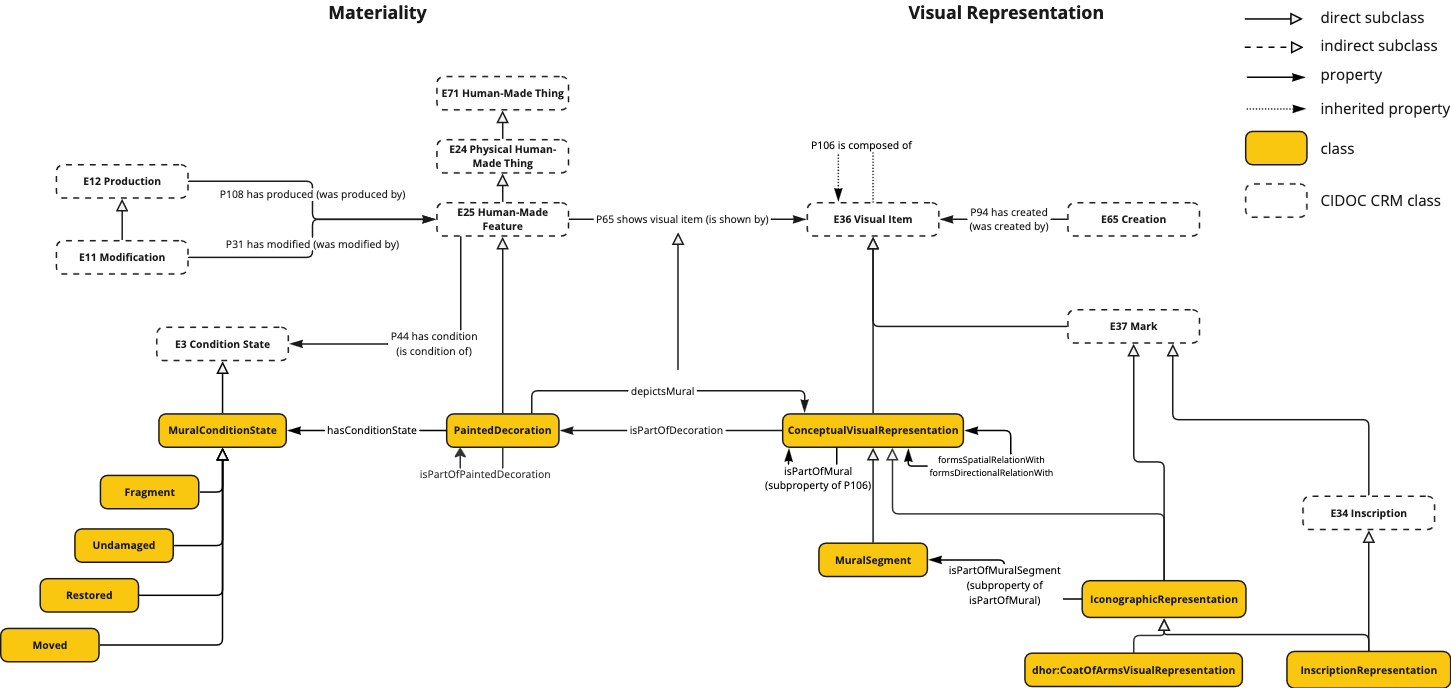
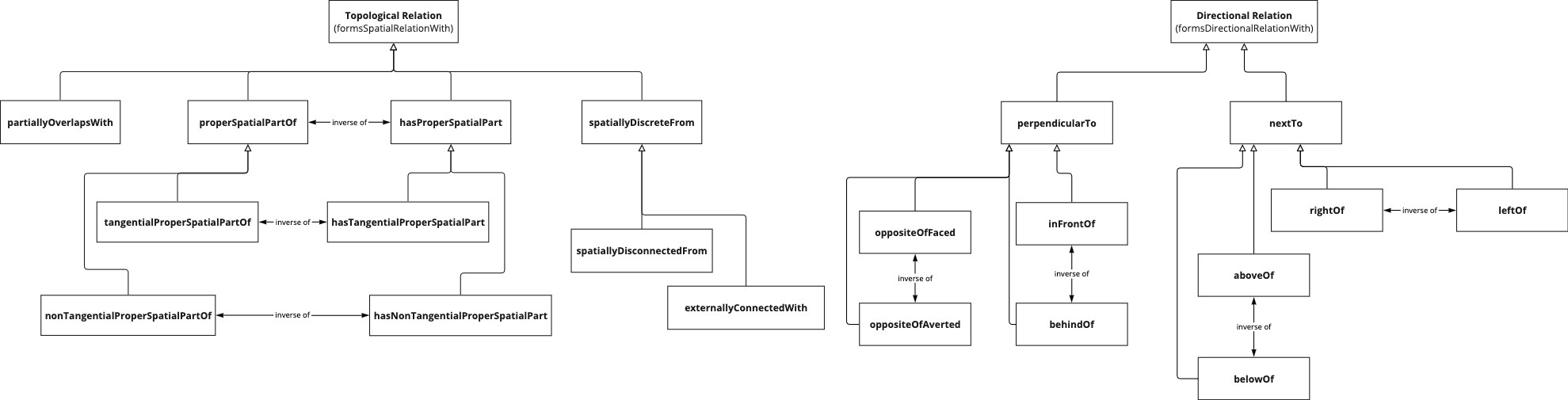
Alignment to CIDOC CRM is published as a separate alignment file, so that the pattern can be reused without committing an adopter to a particular upper model.
Cross-reference for SICON – Spatial Iconography Ontology classes, object properties and data properties back to ToC
This section provides details for each class and property defined by SICON – Spatial Iconography Ontology.Classes
- conceptual visual representation
- condition state type
- iconographic representation
- inscription representation
- mural condition state
- mural segment
- painted decoration
conceptual visual representationc back to ToC or Class ToC
IRI: https://w3id.org/sicon#ConceptualVisualRepresentation
- Is defined by
- https://w3id.org/sicon
- Example
-
The heraldic programme of the Great Hall at the castle of Goldegg, comprising the arms on the walls together with the Imperial Quaternions on the painted ceiling, treated as one composition.
- has sub-classes
- iconographic representation c, mural segment c
- is in domain of
- forms directional relation with op, forms spatial relation with op, is part of decoration op, is part of mural op
- is in range of
- depicts mural op, forms directional relation with op, forms spatial relation with op, is part of mural op
- is disjoint with
- mural condition state c, painted decoration c
condition state typec back to ToC or Class ToC
IRI: https://w3id.org/sicon#ConditionStateType
- Is defined by
- https://w3id.org/sicon
- Example
-
The type assigned to the state of a painted beam that was detached from its original town house and is now held by a museum.
- is in range of
- has condition state type op
- has members
- fragment ni, moved ni, restored ni, undamaged ni
iconographic representationc back to ToC or Class ToC
IRI: https://w3id.org/sicon#IconographicRepresentation
- Is defined by
- https://w3id.org/sicon
- Example
-
A single coat of arms in one of the ranked groups of the Imperial Quaternions on the Goldegg ceiling, such as one of the arms of the prince-bishoprics.
- has super-classes
- conceptual visual representation c
- has sub-classes
- inscription representation c
- is in domain of
- is part of mural segment op
inscription representationc back to ToC or Class ToC
IRI: https://w3id.org/sicon#InscriptionRepresentation
- Is defined by
- https://w3id.org/sicon
- Example
-
A banderole naming a territory placed directly beneath the coat of arms it identifies.
- has super-classes
- iconographic representation c
mural condition statec back to ToC or Class ToC
IRI: https://w3id.org/sicon#MuralConditionState
- Is defined by
- https://w3id.org/sicon
- Example
-
The condition of the fourteenth-century beam ceiling from a town house in Metz after its removal to the Musée de la cour d'or.
- is in domain of
- has condition state type op
- is in range of
- has condition state op
- is disjoint with
- conceptual visual representation c, painted decoration c
mural segmentc back to ToC or Class ToC
IRI: https://w3id.org/sicon#MuralSegment
- Is defined by
- https://w3id.org/sicon
- Example
-
One painted side of a single beam of painted ceiling in the Salle d'apparat of the Maison the chevalier in Pont-Saint-Esprit, France (https://upload.wikimedia.org/wikipedia/commons/f/f2/Maison_des_chevaliers_Salle_d%27apparat_rdc.JPG?utm_source=commons.wikimedia.org&utm_campaign=index&utm_content=original&uselang=fr). The individual field on that beam bearing one coat of arms, and the ceiling as a whole are three instances standing in part-whole relations.
- has super-classes
- conceptual visual representation c
- is in range of
- is part of mural segment op
painted decorationc back to ToC or Class ToC
IRI: https://w3id.org/sicon#PaintedDecoration
- Is defined by
- https://w3id.org/sicon
- Example
-
The paint layer on the beams of the fourteenth-century ceiling from a town house in Metz, now in the Musée de la cour d'or.
- is in domain of
- depicts mural op, has condition state op, is part of painted decoration op
- is in range of
- is part of decoration op, is part of painted decoration op
- is disjoint with
- conceptual visual representation c, mural condition state c
Object Properties
- above of
- behind of
- below of
- depicts mural
- externally connected with
- forms directional relation with
- forms spatial relation with
- has condition state
- has condition state type
- has non-tangential proper spatial part
- has proper spatial part
- has tangential proper spatial part
- in front of
- is part of decoration
- is part of mural
- is part of mural segment
- is part of painted decoration
- left of
- next to
- non-tangential proper spatial part of
- opposite of, averted
- opposite of, faced
- partially overlaps with
- perpendicular to
- proper spatial part of
- right of
- spatially disconnected from
- spatially discrete from
- tangential proper spatial part of
above ofop back to ToC or Object Property ToC
IRI: https://w3id.org/sicon#aboveOf
- Is defined by
- https://w3id.org/sicon
behind ofop back to ToC or Object Property ToC
IRI: https://w3id.org/sicon#behindOf
- Is defined by
- https://w3id.org/sicon
- Example
-
A decorated screen or partition standing between a viewer at the entrance of a hall and the painted end wall.
has characteristics: asymmetric
- has super-properties
- perpendicular to op
- is inverse of
- in front of op
below ofop back to ToC or Object Property ToC
IRI: https://w3id.org/sicon#belowOf
- Is defined by
- https://w3id.org/sicon
- Example
-
An inscription placed beneath the coat of arms it names stands below that coat of arms.
depicts muralop back to ToC or Object Property ToC
IRI: https://w3id.org/sicon#depictsMural
- Is defined by
- https://w3id.org/sicon
- has domain
- painted decoration c
- has range
- conceptual visual representation c
externally connected withop back to ToC or Object Property ToC
IRI: https://w3id.org/sicon#externallyConnectedWith
- Is defined by
- https://w3id.org/sicon
- Example
-
Two adjacent fields on the same beam of the Metz ceiling, separated by a painted dividing line but sharing that border.
has characteristics: symmetric
- has super-properties
- spatially discrete from op
forms directional relation withop back to ToC or Object Property ToC
IRI: https://w3id.org/sicon#formsDirectionalRelationWith
- Is defined by
- https://w3id.org/sicon
- Example
-
The arrangement of the Imperial Quaternions at Goldegg into ranked rows and groups is expressed entirely through sub-properties of this property.
- has sub-properties
- next to op, perpendicular to op
- has domain
- conceptual visual representation c
- has range
- conceptual visual representation c
forms spatial relation withop back to ToC or Object Property ToC
IRI: https://w3id.org/sicon#formsSpatialRelationWith
- Is defined by
- https://w3id.org/sicon
- Example
-
The relation between a heraldic frieze and the wall surface that carries it, and the relation between two neighbouring fields within that frieze, are both expressed through sub-properties of this property.
- has sub-properties
- has proper spatial part op, partially overlaps with op, proper spatial part of op, spatially discrete from op
- has domain
- conceptual visual representation c
- has range
- conceptual visual representation c
has condition stateop back to ToC or Object Property ToC
IRI: https://w3id.org/sicon#hasConditionState
- Is defined by
- https://w3id.org/sicon
- Example
-
The paint on one field of a Metz beam is recorded with a state typed as fragmentary, while the neighbouring field is recorded as undamaged.
- has domain
- painted decoration c
- has range
- mural condition state c
has condition state typeop back to ToC or Object Property ToC
IRI: https://w3id.org/sicon#hasConditionStateType
- Is defined by
- https://w3id.org/sicon
- Example
-
The state of a detached and subsequently repaired beam carries both the relocated and the restored type.
- has domain
- mural condition state c
- has range
- condition state type c
has non-tangential proper spatial partop back to ToC or Object Property ToC
IRI: https://w3id.org/sicon#hasNonTangentialProperSpatialPart
- Is defined by
- https://w3id.org/sicon
- Example
-
A field on a Metz beam contains a coat of arms placed centrally within it, clear of the painted border.
- has super-properties
- has proper spatial part op
- is inverse of
- non-tangential proper spatial part of op
has proper spatial partop back to ToC or Object Property ToC
IRI: https://w3id.org/sicon#hasProperSpatialPart
- Is defined by
- https://w3id.org/sicon
- Example
-
The Goldegg ceiling contains the group of arms of the imperial cities, which in turn contains each individual coat of arms in that group.
has characteristics: asymmetric
- has super-properties
- forms spatial relation with op
- has sub-properties
- has non-tangential proper spatial part op, has tangential proper spatial part op
- is inverse of
- proper spatial part of op
has tangential proper spatial partop back to ToC or Object Property ToC
IRI: https://w3id.org/sicon#hasTangentialProperSpatialPart
- Is defined by
- https://w3id.org/sicon
- Example
-
A frieze running along the upper edge of a wall occupies a part of that wall which touches its boundary.
- has super-properties
- has proper spatial part op
- is inverse of
- tangential proper spatial part of op
in front ofop back to ToC or Object Property ToC
IRI: https://w3id.org/sicon#inFrontOf
- Is defined by
- https://w3id.org/sicon
- Example
-
A painted partition stands in front of the end wall of a hall as seen from the entrance.
has characteristics: asymmetric
- has super-properties
- perpendicular to op
- is inverse of
- behind of op
is part of decorationop back to ToC or Object Property ToC
IRI: https://w3id.org/sicon#isPartOfDecoration
- Is defined by
- https://w3id.org/sicon
- Example
-
The composition showing a white horse and an emblem is realised on the seventeenth-century paint layer of the Metz beam that bears it.
- has domain
- conceptual visual representation c
- has range
- painted decoration c
is part of muralop back to ToC or Object Property ToC
IRI: https://w3id.org/sicon#isPartOfMural
- Is defined by
- https://w3id.org/sicon
- Example
-
A painted wall of a room is part of the decoration of that room taken as a single composition.
has characteristics: transitive
- has sub-properties
- is part of mural segment op
- has domain
- conceptual visual representation c
- has range
- conceptual visual representation c
is part of mural segmentop back to ToC or Object Property ToC
IRI: https://w3id.org/sicon#isPartOfMuralSegment
- Is defined by
- https://w3id.org/sicon
- Example
-
Each coat of arms of the Imperial Quaternions is part of the ceiling composition of the Great Hall at Goldegg.
- has super-properties
- is part of mural op
- has domain
- iconographic representation c
- has range
- mural segment c
is part of painted decorationop back to ToC or Object Property ToC
IRI: https://w3id.org/sicon#isPartOfPaintedDecoration
- Is defined by
- https://w3id.org/sicon
- Example
-
The paint on one beam is part of the paint layer of the Metz ceiling as a whole.
has characteristics: transitive
- has domain
- painted decoration c
- has range
- painted decoration c
left ofop back to ToC or Object Property ToC
IRI: https://w3id.org/sicon#leftOf
- Is defined by
- https://w3id.org/sicon
- Example
-
Within a row of the Imperial Quaternions at Goldegg, each shield stands to the left of the next shield in that row.
next toop back to ToC or Object Property ToC
IRI: https://w3id.org/sicon#nextTo
- Is defined by
- https://w3id.org/sicon
- Example
-
Two coats of arms placed side by side in a heraldic frieze.
has characteristics: symmetric
- has super-properties
- forms directional relation with op
- has sub-properties
- above of op, below of op, left of op, right of op
non-tangential proper spatial part ofop back to ToC or Object Property ToC
IRI: https://w3id.org/sicon#nonTangentialProperSpatialPartOf
- Is defined by
- https://w3id.org/sicon
- Example
-
A coat of arms placed centrally within a field, clear of its painted border, lies non-tangentially within that field.
- has super-properties
- proper spatial part of op
- is inverse of
- has non-tangential proper spatial part op
opposite of, avertedop back to ToC or Object Property ToC
IRI: https://w3id.org/sicon#oppositeOfAverted
- Is defined by
- https://w3id.org/sicon
- Example
-
The two opposite painted faces of a single ceiling beam, which no observer in the room can take in at once.
has characteristics: symmetric
- has super-properties
- perpendicular to op
opposite of, facedop back to ToC or Object Property ToC
IRI: https://w3id.org/sicon#oppositeOfFaced
- Is defined by
- https://w3id.org/sicon
- Example
-
Coats of arms on the two facing long walls of a fully painted room, arranged so that each faces its counterpart across the space.
has characteristics: symmetric
- has super-properties
- perpendicular to op
partially overlaps withop back to ToC or Object Property ToC
IRI: https://w3id.org/sicon#partiallyOverlapsWith
- Is defined by
- https://w3id.org/sicon
- Example
-
On a painted ceiling in the Musée de la Cour d'Or in Metz, France, the seventeenth-century overpainting occupies an area that only partly coincides with the fourteenth-century field beneath it.
has characteristics: symmetric
- has super-properties
- forms spatial relation with op
perpendicular toop back to ToC or Object Property ToC
IRI: https://w3id.org/sicon#perpendicularTo
- Is defined by
- https://w3id.org/sicon
- Example
-
Coats of arms on a wall and on the beam ceiling above it lie on surfaces that are not coplanar.
- has super-properties
- forms directional relation with op
- has sub-properties
- behind of op, in front of op, opposite of, averted op, opposite of, faced op
proper spatial part ofop back to ToC or Object Property ToC
IRI: https://w3id.org/sicon#properSpatialPartOf
- Is defined by
- https://w3id.org/sicon
- Example
-
A heraldic frieze occupies an area that is a proper part of the wall surface carrying it.
has characteristics: asymmetric
- has super-properties
- forms spatial relation with op
- has sub-properties
- non-tangential proper spatial part of op, tangential proper spatial part of op
- is inverse of
- has proper spatial part op
right ofop back to ToC or Object Property ToC
IRI: https://w3id.org/sicon#rightOf
- Is defined by
- https://w3id.org/sicon
- Example
-
Within a row of the Imperial Quaternions at Goldegg, each shield stands to the right of the shield preceding it.
spatially disconnected fromop back to ToC or Object Property ToC
IRI: https://w3id.org/sicon#spatiallyDisconnectedFrom
- Is defined by
- https://w3id.org/sicon
- Example
-
Two coats of arms of the same heraldic programme placed on opposite walls of a painted room.
has characteristics: symmetric
- has super-properties
- spatially discrete from op
spatially discrete fromop back to ToC or Object Property ToC
IRI: https://w3id.org/sicon#spatiallyDiscreteFrom
- Is defined by
- https://w3id.org/sicon
- Example
-
A written source records two coats of arms as separate elements of one programme without indicating whether their fields adjoined.
has characteristics: symmetric
- has super-properties
- forms spatial relation with op
- has sub-properties
- externally connected with op, spatially disconnected from op
tangential proper spatial part ofop back to ToC or Object Property ToC
IRI: https://w3id.org/sicon#tangentialProperSpatialPartOf
- Is defined by
- https://w3id.org/sicon
- Example
-
A frieze running along the upper edge of a wall lies within that wall and touches its boundary.
- has super-properties
- proper spatial part of op
- is inverse of
- has tangential proper spatial part op
Annotation Properties
- abstract
- bibliographic Citation
- code Repository
- created
- creator
- description
- example
- is native to
- license
- modified
- name
- preferred Namespace Prefix
- preferred Namespace Uri
- publisher
- scope Note
- title
abstractap back to ToC or Annotation Property ToC
IRI: http://purl.org/dc/terms/abstract
bibliographic Citationap back to ToC or Annotation Property ToC
IRI: http://purl.org/dc/terms/bibliographicCitation
code Repositoryap back to ToC or Annotation Property ToC
IRI: https://schema.org/codeRepository
createdap back to ToC or Annotation Property ToC
IRI: http://purl.org/dc/terms/created
creatorap back to ToC or Annotation Property ToC
IRI: http://purl.org/dc/terms/creator
descriptionap back to ToC or Annotation Property ToC
IRI: http://purl.org/dc/terms/description
exampleap back to ToC or Annotation Property ToC
IRI: http://www.w3.org/2004/02/skos/core#example
is native toap back to ToC or Annotation Property ToC
IRI: https://w3id.org/opla-core#isNativeTo
licenseap back to ToC or Annotation Property ToC
IRI: http://purl.org/dc/terms/license
modifiedap back to ToC or Annotation Property ToC
IRI: http://purl.org/dc/terms/modified
nameap back to ToC or Annotation Property ToC
IRI: http://xmlns.com/foaf/0.1/name
preferred Namespace Prefixap back to ToC or Annotation Property ToC
IRI: http://purl.org/vocab/vann/preferredNamespacePrefix
preferred Namespace Uriap back to ToC or Annotation Property ToC
IRI: http://purl.org/vocab/vann/preferredNamespaceUri
publisherap back to ToC or Annotation Property ToC
IRI: http://purl.org/dc/terms/publisher
scope Noteap back to ToC or Annotation Property ToC
IRI: http://www.w3.org/2004/02/skos/core#scopeNote
titleap back to ToC or Annotation Property ToC
IRI: http://purl.org/dc/terms/title
Named Individuals
0000 0002 6743 8600ni back to ToC or Named Individual ToC
IRI: https://orcid.org/0000-0002-6743-8600
digital history enni back to ToC or Named Individual ToC
IRI: https://www.geschichte.hu-berlin.de/en/bereiche-und-lehrstuehle-en/digital-history-en
- belongs to
- Organization c
- has facts
- name ap "Digital History, Humboldt-Universität zu Berlin"@en
fragmentni back to ToC or Named Individual ToC
IRI: https://w3id.org/sicon#Fragment
- Is defined by
- https://w3id.org/sicon
- belongs to
- condition state type c
- has facts
- example ap "A wall bearing part of a cycle of the Nine Worthies together with documented areas of loss where further figures are presumed to have stood."@en
- scope Note ap "Fragmentariness is recorded as a condition of the material stratum, not as a kind of composition. A fragmentary area remains an ordinary sicon:MuralSegment and enters the same spatial relations as a preserved one, which is what allows CQ-5 to count surviving elements of a defined programme alongside documented gaps and so to argue that the cycle was once complete. Modelling it as a state also avoids the difficulty that a decoration would otherwise change class whenever new evidence about its former extent came to light."@en
- is native to ap SICON – Spatial Iconography Ontology ep
movedni back to ToC or Named Individual ToC
IRI: https://w3id.org/sicon#Moved
- Is defined by
- https://w3id.org/sicon
- belongs to
- condition state type c
- has facts
- example ap "The fourteenth-century beam ceiling taken from a town house in Metz and now held by the Musée de la cour d'or."@en
- scope Note ap "Relocation matters for source criticism rather than for material integrity: a decoration removed to a museum may be perfectly preserved yet no longer legible in relation to the room, the openings and the furnishings that once conditioned how it was seen. Recording the state marks that the surrounding context has been lost even where the object has not."@en
- is native to ap SICON – Spatial Iconography Ontology ep
restoredni back to ToC or Named Individual ToC
IRI: https://w3id.org/sicon#Restored
- Is defined by
- https://w3id.org/sicon
- belongs to
- condition state type c
- has facts
- example ap "A heraldic frieze whose losses were filled in during a nineteenth-century campaign, so that the arms now visible are in part the work of the restorer."@en
- scope Note ap "Restoration is recorded because it bears directly on the evidential value of what is now visible: a restored area may reproduce, approximate or silently invent the state it purports to recover, and must be weighed differently as a source. The state does not distinguish degrees or methods of intervention, which should be documented through the modification events of the decoration concerned."@en
- is native to ap SICON – Spatial Iconography Ontology ep
undamagedni back to ToC or Named Individual ToC
IRI: https://w3id.org/sicon#Undamaged
- Is defined by
- https://w3id.org/sicon
- belongs to
- condition state type c
- has facts
- example ap "A field on a Metz beam whose painted surface survives entire, next to a neighbouring field recorded as fragmentary."@en
- scope Note ap "The type should be assigned only where the completeness of the decoration is positively attested, and not by default where nothing is known: the pattern is built on the principle that absence of evidence about loss is not evidence of its absence. Assigning it does not exclude the relocated or restored types, which concern context and intervention rather than extent."@en
- is native to ap SICON – Spatial Iconography Ontology ep
Legend back to ToC
op: Object Properties
ni: Named Individuals
ep: External Properties
References back to ToC
Add your references here. It is recommended to have them as a list.Acknowledgments back to ToC
The authors would like to thank Silvio Peroni for developing LODE, a Live OWL Documentation Environment, which is used for representing the Cross Referencing Section of this document and Daniel Garijo for developing Widoco, the program used to create the template used in this documentation.